Blogs
GHK-Cu vs AHK-Cu: How Copper Peptide Complexes Are Characterized
Oct
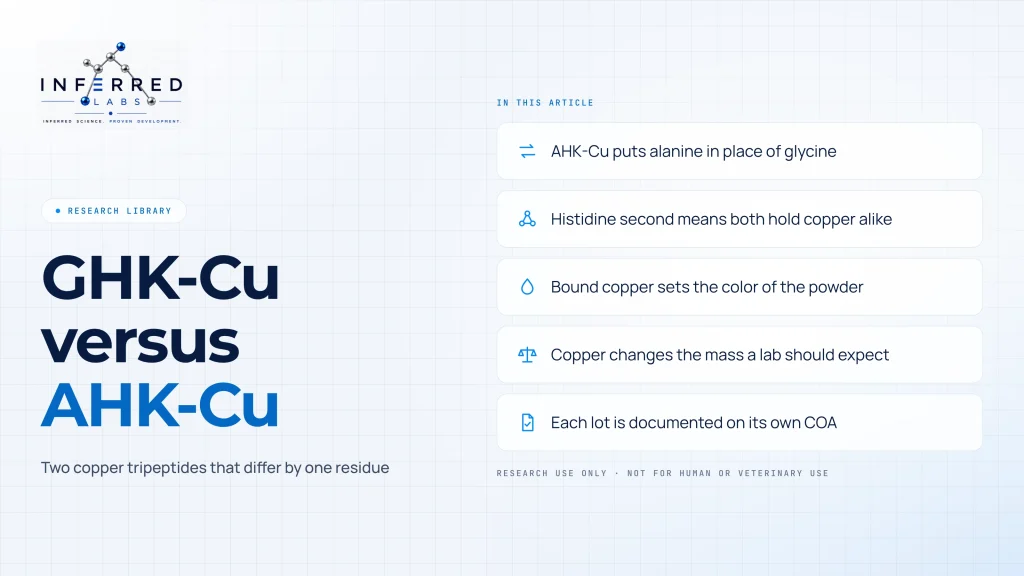
GHK-Cu and AHK-Cu differ by one residue. GHK-Cu is glycyl-histidyl-lysine with copper(II) attached, while AHK-Cu puts alanine in place of the first glycine. Both keep histidine second, so both hold copper the same way.
That shared copper is what a buyer should compare. For example, it sets the color of the powder, shifts the mass that LC-MS sees and changes how you read a lot record.
This GHK-Cu vs AHK-Cu guide covers identity, analysis, documentation and storage for both copper peptide complexes. We supply each as a single 100 mg vial. Start with the GHK-Cu vial size and specifications and compare them with the AHK-Cu product page if your plan calls for the alanine analog.
| Product | GHK-Cu (copper tripeptide-1, glycyl-L-histidyl-L-lysine copper complex) |
|---|---|
| Vial sizes | 100 mg |
| Form | Lyophilized powder, copper(II) peptide complex |
| Sequence | Gly-His-Lys, 3 amino acids, copper(II) complex |
| Molecular formula | C14H22CuN6O4 |
| Molecular weight | 401.9 g/mol |
| CAS number | 89030-95-5 |
| Storage (unopened) | Sealed vial stored dry at −20°C or below, protected from light and moisture |
| Documentation | Lot specific certificate of analysis in the COA library |
GHK-Cu vs AHK-Cu at the sequence level
First, each compound starts as a linear tripeptide. The free GHK peptide, glycyl-L-histidyl-L-lysine, is C14H24N6O4 in its PubChem record. Similarly, the free AHK peptide, L-alanyl-L-histidyl-L-lysine, is C15H26N6O4 in the matching PubChem entry. The extra carbon and two hydrogens are the methyl side chain of alanine.
GHK-Cu, copper tripeptide-1
Gly-His-Lys complexed with copper(II), listed as C14H22CuN6O4, 401.9 g/mol, CAS 89030-95-5.
AHK-Cu, copper tripeptide-3
Ala-His-Lys complexed with copper(II), described as a blue to light blue lyophilized powder. However, the record lists no CAS number.
Both sit in the Modified Peptides category, because copper(II) complexation modifies the base sequence. Next, compare the two GHK formulas: the complex has two fewer hydrogens than the free peptide, plus one copper atom. In other words, that difference is the copper binding itself.
Why the copper complex matters for analysis
To begin with, histidine in the second position defines the Xxx-His motif. A review of N-terminal copper binding motifs describes copper(II) held here by three nitrogens: the N-terminal amine, the first amide nitrogen and the histidine imidazole, with the fourth position occupied by water, buffer or another external molecule. In fact, GHK and AHK both fit the motif. However, the first residue changes the neighboring side chain, which the review notes can shift affinity without joining the coordination.
In addition, the bound amide nitrogen gives up its proton, which is why the complex formula loses two hydrogens. As a result, that chemistry shows up in three places.
- Color. Copper(II) in this motif gives a d-d absorption band near 600 nm, and a solution study of Cu(II)GHK places the d-d band at 606 nm. The complex absorbs orange light, so it looks blue.
- Mass. Each bound copper adds about 61 mass units, copper less the two displaced protons. For example, an LC-MS study of a larger copper binding peptide reported a 61 Da difference for one bound copper and separated copper-bound and copper-free forms by reversed-phase chromatography.
- pH sensitivity. The same study also notes that low pH causes a quantitative loss of bound metal, and it ran its separation at basic pH. Therefore, an acidic method can show the free peptide rather than the complex.
For a copper peptide, the appearance line on a certificate is a quick identity cross check. A blue to light blue powder fits a copper(II) complex. By contrast, a white powder is a question to raise first.
How a copper peptide lot is tested and documented
Before release, an independent laboratory analyzes every Inferred Labs lot, using RP-HPLC for purity and LC-MS for identity confirmation. We do not quote one purity figure for the whole catalog. Instead, the lot certificate states the measured result for that lot.
Freedom Diagnostics currently issues our certificates. For a copper complex, read these fields together, since they cross check each other.
- Lot and accession number. The lot ties the certificate to the vial.
- Identity. Confirmed or not by LC-MS, backed by the mass confirmation spectrum.
- Appearance. The color and form of the sample as received.
- Purity and net content. Purity by HPLC-UV with its chromatogram, and net content reported separately.
We publish certificates against the lot number, not the product page. As a result, the certificate you read is the certificate for the vial you receive. The vial label carries the lot number, and the label QR code also opens the certificate for that lot. The COA library lets you search by compound name, lot number or lab accession number.
Review the GHK-Cu vial size and identity data on the product page, then search the COA library by lot number.
See vial sizes and specs Search the COA libraryWhat copper peptide research has examined
In general, published work here is mostly coordination chemistry. Specifically, the studies cited in this guide are in vitro solution studies of how GHK binds copper, describing chemistry in a cuvette rather than anything in a living organism.
- Binding and affinity. The motif review tabulates binding constants for GHK measured at pH 7.4.
- Redox chemistry. The Cu(II)GHK study examined how glutathione reduces the bound copper, using UV-vis spectroscopy and ESI-MS.
- Ternary complexes. A separate in vitro study examined a second small ligand in the open fourth position of Cu(II)GHK.
However, two limits apply. pH, buffer and the copper to peptide ratio change which species forms, so each result holds only for its reported conditions. These studies also use GHK, so this guide reads AHK through the shared motif.
Storing and preparing a copper peptide vial
We ship lyophilized material cold, so move it into freezer storage on arrival. Then store the sealed vial dry at −20°C or below, protected from light and moisture.
- Record concentration in mg/mL. Base the stock concentration on net content from the lot certificate rather than the labeled 100 mg, and note which figure you used.
- Note the pH and buffer. Buffer components can occupy the open copper position, and low pH strips copper, so the solvent is part of the experiment.
- Check the color. A loss of blue color after dissolving is worth recording, since it can point to a change in the copper species.
- Label every aliquot. Carry the lot number onto each tube so results trace back to the certificate.
What to confirm before and after ordering
Research Use Only states the only intended use of these products. Under 21 CFR 201.128, FDA reads intended use from the objective intent of the people responsible for a product, so the documentation trail matters. Inferred Labs sells to adults aged 21 or over, for in vitro laboratory research only. Before ordering, confirm the identity data on the GHK-Cu product listing. Then, after delivery, match the vial to its record in the lot certificate library.
- GHK-Cu or AHK-Cu chosen by the first residue, glycine or alanine
- The 100 mg vial size fits the quantity of material the run needs
- The lot number on the vial label matches the certificate you open
- That certificate confirms identity by LC-MS
- The appearance line fits a blue copper(II) complex
- The sealed vial went into freezer storage at −20°C or below on arrival
- You record stock concentration in mg/mL, pH and buffer for each solution
Check the certificate for your lot number in the COA library, then review the vial size and specifications on the GHK-Cu product page.
View the GHK-Cu listing Open the COA library- GHK-Cu and AHK-Cu differ only in the first residue, glycine or alanine
- Both hold copper(II) through the same three nitrogens of the Xxx-His motif
- The copper sets the blue color, adds about 61 mass units and comes off at low pH
- An independent lab tests each lot by RP-HPLC and LC-MS before release, with one certificate per lot
- Store sealed vials dry and dark at −20°C or below
Frequently asked questions
One residue. GHK-Cu is a copper(II) complex of glycyl-histidyl-lysine, while AHK-Cu replaces the first glycine with alanine, adding a methyl side chain. Both keep histidine second, so both hold copper through the same amine, amide and imidazole nitrogens. GHK-Cu carries CAS 89030-95-5, while the AHK-Cu record shows no CAS number.
The color comes from the copper(II) ion. Because nitrogen donors hold it, copper absorbs visible light in a d-d transition, near 600 nm for this motif. As a result, absorbing orange light leaves the complex looking blue. Similarly, the AHK-Cu product page describes a blue to light blue lyophilized powder.
RP-HPLC with UV detection measures purity, and LC-MS confirms identity from the mass. Copper adds about 61 mass units to the free peptide, and acidic conditions can strip it, so the free peptide may appear in the data alongside or in place of the complex. Finally, the appearance line is a useful third check.
Vial size and storage
We supply both as a single 100 mg vial of lyophilized copper peptide complex. The vial size is the labeled quantity, while the lot certificate reports the measured net content. Also, the price per vial steps down when you order two, three or ten or more vials of the same product.
Move the vial into freezer storage as soon as it arrives, since we ship lyophilized material cold. Then store the sealed vial dry at −20°C or below, protected from light and moisture. Also, record the lot number in your inventory so that you can trace the material to its certificate.
Finding your certificate
Read the lot number printed on the vial label, then search the COA library by lot number, compound name or lab accession number. The label QR code also opens the certificate for that lot. We publish certificates against the lot number, so the certificate you read matches the vial you received.
- Glycyl-L-histidyl-L-lysine, PubChem CID 73587. National Library of Medicine. View source
- L-Alanyl-L-histidyl-L-lysine, PubChem CID 7408502. National Library of Medicine. View source
- Gonzalez P, Bossak K, Stefaniak E, et al., 2018. N-terminal Cu binding motifs Xxx-Zzz-His (ATCUN) and Xxx-His and their derivatives: chemistry, biology and medicinal applications. Chemistry: A European Journal, 24(32), 8029 to 8041. View source
- Ufnalska I, Drew SC, Zhukov I, et al., 2021. Intermediate Cu(II)-thiolate species in the reduction of Cu(II)GHK by glutathione: a handy chelate for biological Cu(II) reduction. Inorganic Chemistry, 60(23), 18048 to 18057. View source
- Abbas IM, Vranic M, Hoffmann H, et al., 2018. Investigations of the copper peptide hepcidin-25 by LC-MS/MS and NMR. International Journal of Molecular Sciences, 19(8), 2271. DOI
- Bossak-Ahmad K, Wiśniewska MD, Bal W, Drew SC, Frączyk T, 2020. Ternary Cu(II) complex with GHK peptide and cis-urocanic acid as a potential physiologically functional copper chelate. International Journal of Molecular Sciences, 21(17), 6190. View source
- 21 CFR 201.128 (meaning of intended uses). Code of Federal Regulations, eCFR current edition. View source
Inferred Labs sells all products for Research Use Only: not for human or veterinary use, not for diagnostic use, and not for use as a food, drug, dietary supplement or cosmetic. We restrict sale to adults aged 21 or over. This article is general information for laboratory buyers and is not medical, legal or regulatory advice. Specifications and test results apply to the specific lot shown on its certificate of analysis.