Research library
Peptide research guides and lab notes
Plain, documented reading for the lab: how research peptides are tested, how to read a Certificate of Analysis (COA), and how to store and prepare material for analytical work.

Where to Buy BPC-157
Buy BPC-157 in the USA from Inferred Labs, where the BPC-157 product page lists a 10 mg vial at $50 [...]
Nov
Where to Buy Research Peptides in the USA (2026): Prices, COAs and Shipping
You can buy research peptides in the USA from Inferred Labs, a Las Vegas, Nevada supplier that lists the price, [...]
Nov
How to Store Lyophilized Research Peptides: Temperature, Light and Moisture
Freezer storage at -20 C, keeping vials dry and dark, warming before opening, mg/mL stock solutions and aliquoting: lyophilized peptide [...]
Oct
Peptide Blends Explained: What Is in a Co-Lyophilized Vial and How It Is Tested
What a peptide blend is, what co-lyophilized means, and what a multi component certificate must show. With KLOW, GLOW and [...]
Oct
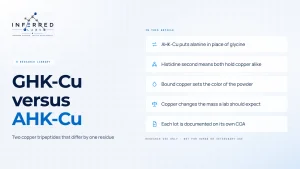
GHK-Cu vs AHK-Cu: How Copper Peptide Complexes Are Characterized
GHK-Cu and AHK-Cu are copper(II) tripeptide complexes. Compare sequence, structure and color, and see how a copper peptide lot is [...]
Oct

MOTS-c and NAD+ for Mitochondrial Research: Structure, Testing and Handling
MOTS-c is a 16 residue peptide and NAD+ a dinucleotide. Compare structure, vial sizes, lot testing and freezer storage before [...]
Oct
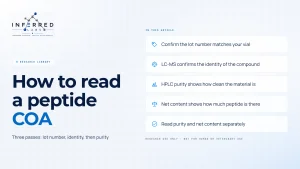
How to Read a Peptide Certificate of Analysis: HPLC Purity and LC-MS Identity
A field by field guide to a research peptide certificate of analysis: lot, accession number, HPLC purity, net content and [...]
Oct
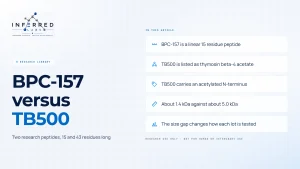
BPC-157 vs TB500: Sequence, Structure and How Each Lot Is Tested
Compare BPC-157 and TB500 by sequence, length and structure, see how each lot is tested by HPLC and LC-MS, and [...]
Oct
Articles are educational and describe laboratory testing, documentation and handling only. All Inferred Labs products are sold for in-vitro laboratory research. Not for human or veterinary use.