Blogs
How to Read a Peptide Certificate of Analysis: HPLC Purity and LC-MS Identity
Oct
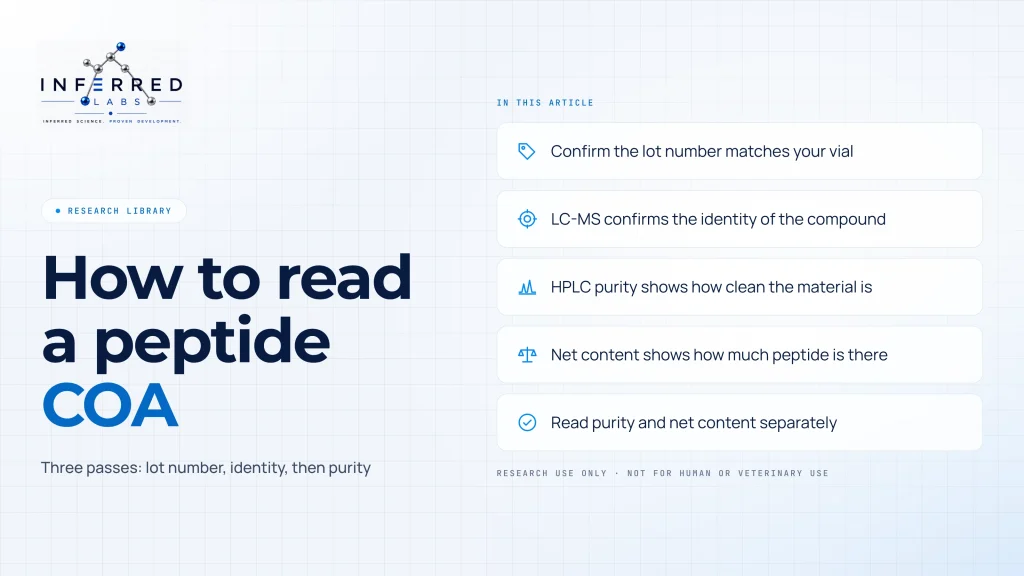
Read a peptide certificate of analysis in three passes: confirm the lot number matches your vial, check that LC-MS confirms identity, then read HPLC purity and net content as two separate measurements. Purity says how clean the compound is, while net content says how much of it is there.
However, a certificate is only useful if it belongs to the vial on your bench. In other words, the lot number, not the product name, ties the two together.
This guide therefore covers how to read a peptide COA field by field, using the current certificate for the Cardiogen 20 mg vial and its specifications as the worked example. Before release, an independent laboratory analyzes every Inferred Labs lot, and we publish each certificate in the Inferred Labs COA library against its lot number.
| Product | Cardiogen |
|---|---|
| Vial sizes | 20 mg |
| Form | White to off white lyophilized powder |
| Sequence | Ala-Glu-Asp-Arg (synthetic tetrapeptide) |
| Molecular formula | C18H31N7O9 |
| Molecular weight | 489.5 g/mol |
| Storage (unopened) | Shipped cold. Move to freezer storage on arrival and keep the sealed vial dry at −20°C or below, protected from light and moisture |
| Documentation | Lot specific certificate of analysis in the COA library |
How to read a peptide COA, field by field
To begin with, any certificate, from any supplier, should answer four questions on its own: which lot was tested, who tested it, what the compound is and how clean it is. A document that cannot answer all four is therefore a product sheet, not a lot certificate.
In addition, the general standard for testing laboratory competence is ISO/IEC 17025, which covers the competence, impartiality and consistent operation of testing and calibration laboratories. It describes how a laboratory runs, not a property of a product, so judge each certificate on its fields.
| Field | What it tells you | What to check |
|---|---|---|
| Lot | The batch tested | Matches your vial label |
| Product | The compound received | Matches your order |
| Accession number | The lab’s sample record | Present and traceable |
| Received and reported dates | When the lab logged and reported | Reported after received |
| Identity | Mass matched the expected compound | Confirmed, spectrum attached |
| Purity | Main peak share by HPLC-UV | At or above the specification |
| Net content | Measured amount of compound | Read beside the vial size |
| Chromatogram and spectrum | The raw traces | Printed, not just described |
Finally, the method line names the technique behind each result. Read it first, because a figure means little until you know how it was measured.
What HPLC purity actually measures
First, peptide purity figures almost always come from reversed phase HPLC. For example, a Waters application note describes reversed phase chromatography as the most commonly used technique for synthetic peptide impurity work, with UV detection at 214 nm, and lists the impurities synthesis introduces: amino acid deletions, insertions and truncated peptides.
Specifically, purity is the area of the main peak as a percentage of all detected peak area. Similarly, published work on peptide reference standards describes HPLC impurities as a percentage of total detected area, while other methods measure counter ions, water and residual solvents separately by weight.
- It is a relative figure. The figure compares the target peak with related impurities, not the amount of material in the vial.
- It leaves out water and counter ions. Other methods measure those, so the percentage says nothing about them.
- The impurities are near relatives. For instance, deletion and truncated sequences differ from the target by a residue or a few.
A release specification is a pass threshold, not a description of every lot. For that reason, Inferred Labs does not quote one purity figure for the whole catalog. Instead, each lot’s own certificate states its measured figure.
Net peptide content versus the label
By contrast, net peptide content asks how much of the powder is the peptide itself. Labs usually isolate synthetic peptides as salts, often trifluoroacetate salts after synthesis and purification. For example, in one study trifluoroacetate made up as much as 35% of total weight in the peptide salts tested. Residual water adds more, which is why the reference standard work above corrects purity for water content.
Gross weight
The total mass of powder: peptide, counter ions and residual water together.
Counter ion
The ion paired with charged groups on the peptide, such as trifluoroacetate or acetate. It adds to the weight of the powder, but it is not part of the sequence.
Net peptide content
The share of the powder that is the peptide, reported by weight and separately from purity.
Gross weight and net content rarely match. However, the gap is not a fault. Therefore, record net content next to the labeled vial size, and note which figure you used for any bench stock concentration in mg/mL.
The Cardiogen listing shows the vial size and specifications, while the lot certificate shows that lot’s measured purity and net content.
See Cardiogen vial specs Look up the lot COAWhat LC-MS identity confirmation shows
Purity says a sample is mostly one compound. Identity, by contrast, says it is the right compound. LC-MS couples the separation to a mass spectrometer, so the instrument weighs each peak as well as measuring it.
A Thermo Fisher Scientific application note explains that analysts assign peaks by comparing theoretical and observed mass, and that the UV trace alone cannot rule out co-eluting impurities. The same note also records peptides across several charge states, so more than one signal is normal for a larger peptide.
Read the identity line, then the spectrum. Next, the observed mass should be consistent with the molecular weight in the product specifications. In short, identity and purity answer different questions, and neither replaces the other.
Reading the Cardiogen certificate as a worked example
First, search Cardiogen in the COA library. Its current certificate, issued by Freedom Diagnostics, then reads in this order.
- Header. The submitting company, accession number, search code, and received and reported dates. The accession number also finds the certificate in the library.
- Lot and product. The lot matches your vial label, and the product line also reads Cardiogen.
- Identity and appearance. Then compare the spectrum with 489.5 g/mol for Ala-Glu-Asp-Arg, and the appearance line with the powder described on the Cardiogen product listing.
- Purity and net content. Read the measured purity, then net content beside the 20 mg vial size. Both belong to that lot only.
- Results table and traces. Identity by LC-MS, purity by HPLC-UV and net content, backed by the chromatogram, the spectrum and a method line reading HPLC with UV detection coupled with mass spectrometry (LC-MS).
However, other certificates read slightly differently. The NAD+ 1000 mg vial specifications describe a dinucleotide, so the lab checks identity against 663.4 g/mol with no sequence to compare. The GLOW blend components and vial size show BPC-157, TB500 and GHK-Cu in one 70 mg vial, so its certificate should account for every listed component in the identity reporting.
Cardiogen sits in the short chain peptides category, and the same reading order works across the full Inferred Labs catalog.
Match the certificate to the vial you received
We publish certificates against the lot number, not the product page. As a result, the certificate you read is the certificate for the vial you receive. The vial label carries the lot number, and each label also carries a QR code that opens that lot’s certificate. You can also search the certificate library by compound name, lot number or lab accession number.
- Lot number on the label matches the certificate
- QR code opens that same certificate
- Product line matches the product ordered
- Identity reads confirmed, with a mass spectrum printed
- Measured purity read from the lot certificate
- Net content recorded beside the labeled vial size
- Accession number written into the lab notebook
- Sealed vial in freezer storage at −20°C or below, dry and dark
Check the current Cardiogen lot certificate first, then review the vial size and specifications on the product page.
View the Cardiogen listing Open the COA library- Match the lot number on the vial to the certificate first
- HPLC purity is the main peak’s share of detected peak area
- Net content is a separate weight measurement
- LC-MS identity compares observed mass with expected molecular weight
- A specification is a threshold, while the lot figure is on its certificate
Frequently asked questions
A good certificate names the lot, the product and the testing laboratory, with an accession number and received and reported dates. It should also report identity by mass spectrometry, purity by HPLC, appearance and net content, and print the chromatogram, mass spectrum and a method line naming the techniques.
Purity is relative: the main HPLC peak as a share of all detected peak area, describing how clean the compound is. Net content, however, is a weight measurement of how much compound is present, as distinct from the total powder, which also holds counter ions and residual water.
Search the lot number printed on the vial label in the Inferred Labs COA library, or scan the QR code on the label, which opens that lot’s certificate. We publish certificates against the lot number, so the lot field should match your label character for character.
Identity and specifications
It shows that the mass measured for the sample is consistent with the expected mass of the compound. First, chromatography separates the sample, and then the mass spectrometer measures what elutes. The certificate then reports identity as confirmed or not, with the spectrum printed for comparison against the specifications.
Because a specification is a release threshold, not a description of the lot. The lab measures each lot on its own, so a lot can sit above the threshold. The next lot then carries its own figure.
When a lot does not match
Search the COA library again using the lot number exactly as printed, then by compound name, and scan the label QR code. If nothing matches, however, keep the vial sealed in freezer storage, do not file it against another lot, and contact Inferred Labs with the lot number and order details.
- ISO/IEC 17025:2017, General requirements for the competence of testing and calibration laboratories. ISO, 2017. View source
- Yang H, Koza SM, Warren WJ, Chen W, 2018. Synthetic peptide impurity analysis on Waters reversed-phase columns. Waters Corporation, application note 720006244. View source
- McCarthy D, Han Y, Carrick K, et al., 2023. Pharmaceutical Research, 40, 1317 to 1328. DOI
- Erckes V, Streuli A, Chamera Rendueles L, Krämer SD, Steuer C, 2025. Towards a consensus for the analysis and exchange of TFA as a counterion in synthetic peptides and its influence on membrane permeation. Pharmaceuticals, 18(8), 1163. DOI
- Grosse S, Samonig M, De Pra M, Steiner F, 2018. Impurity profiling of the synthetic peptide LL-37 using high-performance liquid chromatography with combined UV and single quadrupole mass spectrometric detection. Thermo Fisher Scientific, application note 72818. View source
Inferred Labs sells all products for Research Use Only: not for human or veterinary use, not for diagnostic use, and not for use as a food, drug, dietary supplement or cosmetic. We restrict sale to adults aged 21 or over. This article is general information for laboratory buyers and is not medical, legal or regulatory advice. Specifications and test results apply to the specific lot shown on its certificate of analysis.