
Blogs
How to Store Lyophilized Research Peptides: Temperature, Light and Moisture
Oct
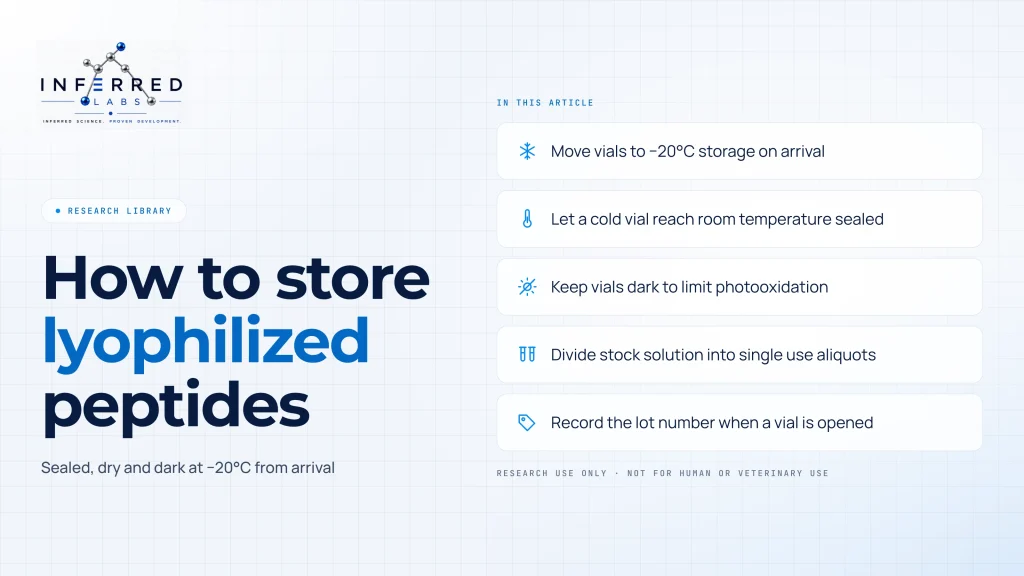
Store lyophilized research peptides sealed, dry and dark in a freezer at −20°C or below, and move them there as soon as the order arrives. Let a cold vial reach room temperature before you open it. Then, once you dissolve the material, divide it into single use aliquots so that no portion goes through more than one freeze and thaw.
However, temperature is only one variable. Moisture, light and air each drive their own degradation routes, and most storage errors happen at the bench, while a vial is open.
This guide covers how to store research peptides from arrival to the point a stock solution goes back into the freezer. It uses Semax as the worked example, because its sequence begins with methionine, a residue that makes oxidation a practical handling concern. The Semax 10 mg vial specifications appear below.
| Product | ACTH(4-7)-Pro-Gly-Pro, also known as Semax |
|---|---|
| Vial sizes | 10 mg |
| Form | White to off white lyophilized powder |
| Sequence | Met-Glu-His-Phe-Pro-Gly-Pro (synthetic peptide, 7 amino acids) |
| Molecular formula | C37H51N9O10S |
| Molecular weight | 813.9 g/mol |
| CAS number | 80714-61-0 |
| Storage (unopened) | Shipped cold. Move into freezer storage on arrival and store the sealed vial dry at −20°C or below, protected from light and moisture |
| Documentation | Lot specific certificate of analysis in the COA library |
How to store research peptides on arrival
Freeze dried peptide is far more stable than the same peptide in solution, but it is not inert. A review of solid state chemistry lists deamidation, peptide bond cleavage, oxidation and aggregation among the reactions that still proceed in dry proteins and peptides, and names temperature and moisture content as factors that govern them (Lai and Topp, 1999).
In fact, lyophilized peptide storage starts the day the box arrives. Inferred Labs ships lyophilized material cold, so move the sealed vials into freezer storage at −20°C or below rather than leaving the box on a bench.
- Steady temperature. Choose a shelf at the back, away from the door, where temperature changes least.
- Dry and dark. Keep vials sealed inside a closed, opaque secondary container, with a desiccant pack if the freezer also holds wet samples.
- Grouped by lot. Store vials from the same lot together, so the lot number on each label matches the certificate on file.
Because the storage statement is the same across the catalog, the routine for the Selank 10 mg listing, the Ipamorelin 10 mg listing and the Semax + Selank blend vial is identical. Semax sits in the short chain peptides category.
Moisture, condensation and opening a cold vial
First, a vial straight from the freezer is colder than the room around it. Open it at once and water from the air condenses on the glass and on the powder, raising the moisture content that the solid state review identifies as a factor in degradation.
- Warm it sealed. Leave the closed vial on the bench until it reaches room temperature, then wipe the outside dry.
- Open it once. Dissolve the full contents in one session, so the powder meets room air once.
- Keep tools dry. Use clean, dry tools and close the vial as soon as you add the solvent.
Confirm the vial size, form and storage statement on the product page, then match the lot number on the label to its certificate.
See Semax vial specs Look up the lot COALight, air and the methionine in Semax
In addition, oxidation is a second route, and sequence decides how much it matters. Semax begins with methionine, and a review of protein instability describes methionine as the amino acid residue most susceptible to oxidation (Akbarian and Chen, 2022). The same review describes direct light damage as restricted to a small number of residues, including tyrosine, tryptophan, cysteine and histidine. Semax contains histidine at position three.
A separate review of photodegradation names tryptophan, tyrosine, phenylalanine and cysteine as the main targets of photooxidation (Kerwin and Remmele, 2007). Similarly, Semax carries phenylalanine at position four. Neither review studied Semax: both summarize chemistry across proteins, so read them as reasons for caution, not measured rates for this compound.
Selank shares the 10 mg vial size and storage statement with Semax, but its sequence contains no methionine. Therefore, reading the sequence before you open a vial shows which precautions matter most.
- Keep it dark. Store vials and aliquots in opaque boxes, away from windows and direct bench lighting.
- Limit air contact. Close vials and tubes promptly and avoid leaving solutions open on the bench.
- Record exposure. Note when you opened a vial and how long any solution sat at room temperature.
Peptide stock solutions and aliquoting peptides
However, once you dissolve a peptide, the protection of the dry state is gone. The 2022 review notes that the dried form is preferable to the soluble form because it avoids hydrolysis and other decomposition in solution. So prepare a peptide stock solution once, at the bench concentration your method specifies in mg/mL, and divide it before it goes into the freezer.
To find concentration, divide the mass of peptide by the volume of solvent, then write it in mg/mL on every label. Also, use the solvent your method calls for, record its identity and lot next to the peptide lot, and note which net content figure from the lot certificate went into the calculation.
Stock solution
One preparation of dissolved peptide at a recorded concentration in mg/mL, made from a whole vial in a single session.
Single use aliquot
A portion of the stock in its own sealed, labeled tube, which you thaw only when you need it. After thawing, it never goes back into the freezer.
Freeze concentration
As water turns to ice, dissolved peptide, buffer salts and other solutes concentrate in the liquid that remains between the crystals.
Freeze concentration is therefore the main reason to avoid repeated freezing and thawing. In a laboratory study of a monoclonal IgG solution frozen at controlled rates, protein and buffer salts built up in the final regions to freeze, and aggregation increased with freezing (Spadiut and colleagues, 2020). An IgG is not a short peptide, and the study examined a single freeze rather than repeated freezing, so it gives no rate for any compound in this catalog. Still, it does show why every extra freeze and thaw is an avoidable stress.
What to check and record when your order arrives
Every vial label carries a lot number and a QR code that opens the certificate for that lot. We publish certificates against the lot number rather than the product page, so the certificate you read is the one for the vial you received. Search the COA library by compound name, lot number or lab accession number, and file the certificate with your storage log.
Then, for Semax, compare the label with the sequence, formula and vial size on the Semax product page. If the box or a vial shows a problem you can see on arrival, such as a cracked vial, a broken seal or a missing label, photograph it and report it promptly through the Inferred Labs contact page.
- Vials arrived sealed, labeled and intact
- Product name and vial size on each label match the order
- Lot number on each label matches a certificate in the COA library
- Sealed vials moved into freezer storage at −20°C or below on arrival
- Date opened, solvent, concentration in mg/mL and aliquot count recorded
- Each aliquot labeled with compound, lot, concentration and date prepared
Check the current lot certificate, then review the vial size, sequence and storage statement on the Semax product page.
View the Semax listing Open the COA library- Move sealed vials into freezer storage at −20°C or below on arrival, dry and dark
- Let a cold vial reach room temperature before you open it
- Dissolve the whole vial once and record the concentration in mg/mL
- Split stock solutions into single use aliquots so that nothing goes through two freeze and thaw cycles
- Match every lot number to its certificate and log each vial you open
Frequently asked questions
Move sealed vials into freezer storage as soon as the order arrives. Inferred Labs ships lyophilized material cold, and every product page gives the same instruction: store the sealed vial dry at −20°C or below, protected from light and moisture. Also, group vials by lot so that you can match each label to its certificate.
A vial straight from the freezer is colder than the room. Opened at once, it collects condensation on the glass and on the powder, and moisture content is one of the factors that governs degradation in dry peptides. Instead, leaving the sealed vial on the bench until it reaches room temperature keeps that water out.
Aliquots and light exposure
Each time a solution freezes, water turns to ice and the dissolved peptide and salts concentrate in the liquid left between the crystals. Repeated freezing and thawing therefore repeats that stress. As a result, single use aliquots mean you thaw each portion once, when you need it, while the rest of the stock stays frozen.
It can. Published reviews of protein degradation describe light driven oxidation at residues including tryptophan, tyrosine, phenylalanine, histidine and cysteine. However, a peptide’s exposure to that risk depends on its sequence. Semax contains histidine and phenylalanine. Therefore, storing every vial in an opaque container is a simple default.
Records and arrival checks
Record the compound, the lot number from the label, the date opened, the solvent and its lot, the mass dissolved, the final concentration in mg/mL and the number of aliquots prepared. With the lot certificate filed alongside, that record lets you trace any result to a specific lot.
First, check that every vial arrived sealed, intact and labeled, and that the product name and vial size match the order. Scan the QR code or search the lot number in the COA library to open its certificate. Then move the vials into freezer storage. Report any problem you can see on arrival promptly through the contact page.
- Lai MC, Topp EM, 1999. Solid-state chemical stability of proteins and peptides. Journal of Pharmaceutical Sciences, 88(5), 489-500. DOI
- Akbarian M, Chen SH, 2022. Instability challenges and stabilization strategies of pharmaceutical proteins. Pharmaceutics, 14(11), 2533. DOI
- Kerwin BA, Remmele RL Jr, 2007. Protect from light: photodegradation and protein biologics. Journal of Pharmaceutical Sciences, 96(6), 1468-1479. DOI
- Spadiut O, Gundinger T, Pittermann B, Slouka C, 2020. Spatially resolved effects of protein freeze-thawing in a small-scale model using monoclonal antibodies. Pharmaceutics, 12(4), 382. DOI
Inferred Labs sells all products for Research Use Only: not for human or veterinary use, not for diagnostic use, and not for use as a food, drug, dietary supplement or cosmetic. We restrict sale to adults aged 21 or over. This article is general information for laboratory buyers and is not medical, legal or regulatory advice. Specifications and test results apply to the specific lot shown on its certificate of analysis.