
Blogs
MOTS-c and NAD+ for Mitochondrial Research: Structure, Testing and Handling
Oct
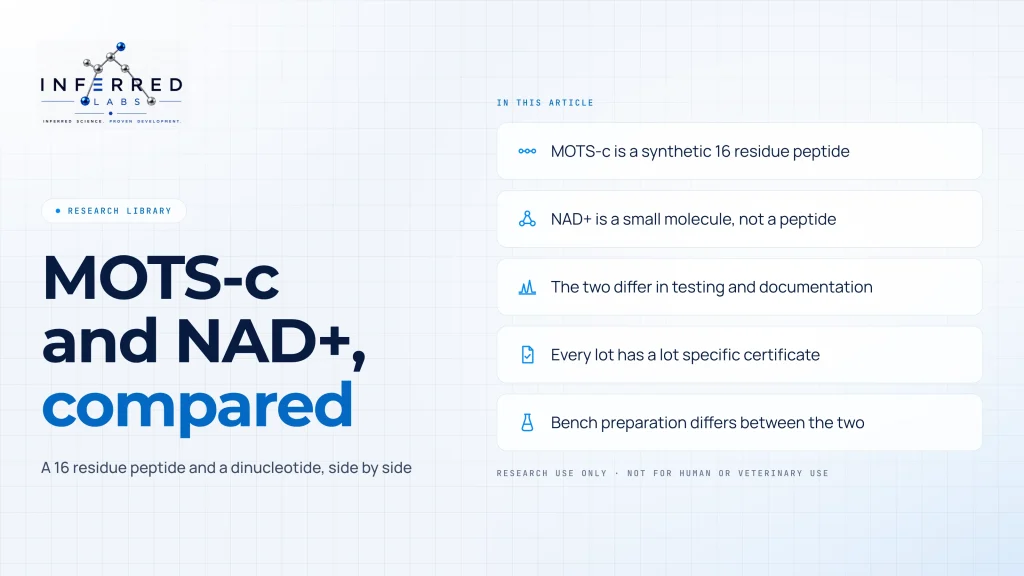
MOTS-c is a synthetic 16 residue peptide and NAD+ is a small molecule dinucleotide. Both appear in mitochondrial research. However, they differ in structure, testing and documentation. Inferred Labs supplies MOTS-c in 10 mg and 40 mg vials and NAD+ in a 1000 mg vial, each with a lot specific certificate.
Therefore, the real buying question is how to confirm that the vial on the bench matches its specification: identity, the lot certificate and freezer storage.
First, ordering a MOTS-c research peptide starts with the specification sheet: sequence, formula, mass and vial format. The MOTS-c vial sizes and specifications appear below. The NAD+ 1000 mg product page also follows the same layout, with a formula and CAS number in place of a sequence.
| Product | MOTS-c (mitochondrial open reading frame of the 12S rRNA type-c) |
|---|---|
| Vial sizes | 10 mg and 40 mg |
| Form | White to off white lyophilized powder |
| Sequence | Met-Arg-Trp-Gln-Glu-Met-Gly-Tyr-Ile-Phe-Tyr-Pro-Arg-Lys-Leu-Arg |
| Molecular formula | C101H152N28O22S2 |
| Molecular weight | 2174.6 g/mol |
| CAS number | 1627580-64-6 |
| Storage (unopened) | Shipped cold. Move into freezer storage on arrival and keep the sealed vial dry at −20°C or below, protected from light and moisture |
| Documentation | Lot specific certificate of analysis in the COA library |
What the MOTS-c research peptide is, and how NAD+ differs
MOTS-c is a linear chain of 16 amino acids, short for mitochondrial open reading frame of the 12S rRNA type-c. The material on the store is synthetic and follows the sequence above. In addition, its formula, C101H152N28O22S2, matches the PubChem record for MOTS-c. The MOTS-c product page also lists the same sequence, formula and CAS number.
In particular, two of the 16 residues are methionine, at positions 1 and 6. They also account for the two sulfur atoms in the formula, and they matter later for handling. On this store MOTS-c sits in the mid chain peptides category.
A 16 residue peptide
The lab confirms identity by matching the measured mass to the mass calculated from the sequence. It then reads purity from a chromatogram of the peptide and its related impurities.
A dinucleotide, not a peptide
NAD+ is beta-nicotinamide adenine dinucleotide: two nucleotides joined through their phosphate groups, C21H27N7O14P2, 663.4 g/mol, CAS 53-84-9. It has no sequence, so its listing identifies it by formula and CAS number.
The NAD+ formula matches its PubChem record, listed there under the name nadide. The plus sign marks the oxidized form of the molecule. By contrast, NADH is the reduced form and a different compound. The store lists NAD+ in the small molecule compounds category.
How each MOTS-c lot is tested and documented
Before release, an independent laboratory analyzes every lot. The lab measures purity by RP-HPLC and confirms identity by LC-MS. We do not quote one purity figure for the whole catalog. Instead, the measured figure belongs to the lot, and its certificate states it.
Freedom Diagnostics currently issues our certificates. Then read the fields in this order.
- Lot and product. The lot must match the vial label, and the product line should read MOTS-c.
- Accession number and dates. These tie the certificate to one sample at one laboratory.
- Identity. Confirmed or not, from LC-MS, with a mass spectrum consistent with the sequence.
- Purity. By HPLC with UV detection, with its chromatogram. Read it from this lot’s certificate, not from another lot.
- Net content. The measured quantity of material, reported separately from purity.
- Method line. “HPLC with UV detection coupled with mass spectrometry (LC-MS)”.
We publish certificates against the lot number, not the product page. As a result, the certificate you read is the certificate for the vial you receive. The COA library lets you search by compound name, lot number or lab accession number. Also, the QR code on each vial label opens the certificate for that lot. We document NAD+ lots the same way under their own lot numbers.
Compare the two vial sizes on the MOTS-c listing, then find the current lot in the COA library.
See vial sizes and specs Look up the lot COAWhat published mitochondrial research has examined
In fact, MOTS-c belongs to a small group of peptides studied as products of mitochondrial DNA. For example, published cell culture work describes it as a peptide encoded in the mitochondrial genome and has examined where it sits inside cultured cells under stress conditions.
However, that kind of study has clear limits. Cultured cells are a simplified system. As a result, an observation in one cell line does not establish what happens in any other system. Labs characterize synthetic peptide for such work with the same identity and purity tests described above, which is why lot documentation matters for comparable in vitro work.
Before reading any claim in a paper on MOTS-c or NAD+, check whether the work used cell culture, an animal model or another system. In short, the model defines what the paper can and cannot say.
Similarly, read NAD+ literature the same way: identify the system first, then the claim.
Storing and preparing MOTS-c and NAD+ on the bench
We ship lyophilized material cold, so move it into freezer storage on arrival. Then store each sealed vial dry at −20°C or below, protected from light and moisture. The same statement also appears on the NAD+ page.
Methionine is the residue to watch in MOTS-c. Methionine residues in proteins readily oxidize to methionine sulfoxide, and MOTS-c carries two of them. An oxidized form carries one extra oxygen atom, so it reads as a separate mass on LC-MS and can appear as a separate peak on HPLC. Therefore, keeping the vial sealed, dry, dark and cold until opening limits exposure to air.
Bench concentration in mg/mL
Express any stock solution in mg/mL, based on the net content on the certificate, since that is the measured quantity of material.
Concentration (mg/mL) = net content (mg) ÷ final volume (mL)
Also, record the lot number, the concentration and the preparation date on every tube. Dividing a stock solution into aliquots sized for one experiment means no tube goes through more than one freeze and thaw. Open any vial only after it has reached room temperature, so condensation does not form on cold powder, and close it promptly after weighing.
What to confirm before and after you order MOTS-c
Use this list with the MOTS-c listing and the lot certificate library open side by side. We restrict orders to adults aged 21 or over, for in vitro laboratory research only. The price per vial steps down when you order two, three or ten or more vials of the same product.
- Vial size chosen so one lot covers the whole planned run
- Current lot certificate found in the COA library before ordering
- Identity reported as confirmed by LC-MS
- Purity read from the lot certificate
- Lot number on the vial label matched to the certificate on arrival
- Vial moved into freezer storage at −20°C or below on arrival
- Lot number, net content and storage date entered in the lab record
Check the current lot certificate in the COA library, then review the vial sizes and specifications on the MOTS-c product page.
View the MOTS-c listing Open the COA library- MOTS-c is a synthetic 16 residue peptide, and NAD+ is a dinucleotide, not a peptide
- MOTS-c comes in 10 mg and 40 mg vials, and NAD+ in a 1000 mg vial
- An independent lab tests every lot by RP-HPLC for purity and LC-MS for identity before release
- We publish each certificate against the lot number printed on the vial
- Store sealed vials dry and dark at −20°C or below
Frequently asked questions
MOTS-c is a synthetic peptide of 16 amino acids with the sequence Met-Arg-Trp-Gln-Glu-Met-Gly-Tyr-Ile-Phe-Tyr-Pro-Arg-Lys-Leu-Arg, the formula C101H152N28O22S2 and a molecular mass of 2174.6 g/mol. The name is short for mitochondrial open reading frame of the 12S rRNA type-c. Inferred Labs supplies it as a white to off white lyophilized powder for in vitro laboratory research only.
No. NAD+ is beta-nicotinamide adenine dinucleotide, a small molecule built from two nucleotides joined through their phosphate groups. It contains no amino acids, which is why the store lists it under small molecule compounds and identifies it by formula, C21H27N7O14P2, and CAS number, 53-84-9, rather than by sequence. We supply it in a 1000 mg vial.
Two sizes: 10 mg and 40 mg, both as lyophilized powder. Choose the size that lets one lot cover the planned run, so every result traces back to a single certificate. The price per vial steps down when you order two, three or ten or more vials of the same product, and the current price and lot are shown on the product page.
Testing and storage
Before release, an independent laboratory analyzes each lot. RP-HPLC measures purity, while LC-MS confirms identity against the mass expected for the sequence. We do not quote one purity figure for the whole catalog. Instead, the measured figure for the lot appears on its certificate, issued by Freedom Diagnostics, together with the chromatogram and the mass confirmation spectrum.
We ship both cold, so they should go into freezer storage on arrival. Then store each sealed vial dry at −20°C or below, protected from light and moisture. Let a vial reach room temperature before opening so condensation does not form on the powder. MOTS-c contains two methionine residues, which are prone to oxidation, so keep its exposure to air short.
Finding your certificate
Read the lot number printed on the vial label, then search for it in the COA library. The library also accepts the compound name or the lab accession number. In addition, each vial label carries a QR code that opens the certificate for that lot directly. We publish certificates against the lot, so the one you open is the certificate for the vial you received.
- Mots-c, PubChem CID 146675088. National Library of Medicine. View source
- Nadide (NAD+), PubChem CID 5892. National Library of Medicine. View source
- Kim KH, Son JM, Benayoun BA, Lee C, 2018. The Mitochondrial-Encoded Peptide MOTS-c Translocates to the Nucleus to Regulate Nuclear Gene Expression in Response to Metabolic Stress. Cell Metabolism, 28(3), 516 to 524.e7. DOI
- Liang X, Kaya A, Zhang Y, Le DT, Hua D, Gladyshev VN, 2012. Characterization of methionine oxidation and methionine sulfoxide reduction using methionine-rich cysteine-free proteins. BMC Biochemistry, 13, 21. DOI
Inferred Labs sells all products for Research Use Only: not for human or veterinary use, not for diagnostic use, and not for use as a food, drug, dietary supplement or cosmetic. We restrict sale to adults aged 21 or over. This article is general information for laboratory buyers and is not medical, legal or regulatory advice. Specifications and test results apply to the specific lot shown on its certificate of analysis.