
Blogs
BPC-157 vs TB500: Sequence, Structure and How Each Lot Is Tested
Oct
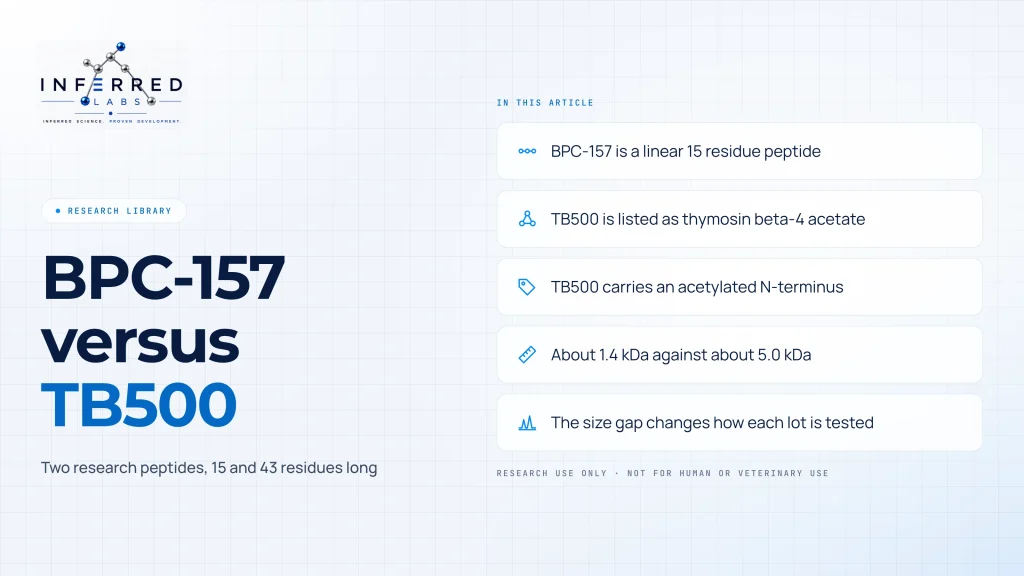
BPC-157 is a synthetic 15 residue peptide of about 1.4 kDa. TB500, as Inferred Labs lists it, is thymosin beta-4 acetate: the full 43 residue sequence with an acetylated N-terminus, at about 5.0 kDa.
That gap in length and mass changes how the lab tests each lot and what its certificate must show, so the useful comparison is structural, not a ranking.
This guide therefore compares BPC-157 vs TB500 by sequence, chain length, terminal chemistry and lot documentation. The BPC-157 vial sizes and specifications appear below, and the TB500 thymosin beta-4 acetate product page lists its single 10 mg format.
| Product | BPC-157 (pentadecapeptide BPC 157, PL 14736) |
|---|---|
| Vial sizes | 10 mg and 20 mg |
| Form | Lyophilized powder, white to off white |
| Sequence | Gly-Glu-Pro-Pro-Pro-Gly-Lys-Pro-Ala-Asp-Asp-Ala-Gly-Leu-Val |
| Molecular formula | C62H98N16O22 |
| Molecular weight | 1419.54 Da |
| CAS number | 137525-51-0 |
| Storage (unopened) | Sealed vial kept dry at −20°C or below, protected from light and moisture |
| Documentation | Lot specific certificate of analysis in the COA library |
BPC-157 vs TB500 at the sequence level
To begin with, published chemistry describes BPC-157 as a 15 amino acid fragment of a gastric juice protein, made by solid phase peptide synthesis. The BPC-157 sequence on the Inferred Labs listing is Gly-Glu-Pro-Pro-Pro-Gly-Lys-Pro-Ala-Asp-Asp-Ala-Gly-Leu-Val, with a molecular formula of C62H98N16O22 and a molecular weight of 1419.54 Da.
We list it under mid chain peptides.
By contrast, researchers first sequenced thymosin beta-4 from calf thymus in 1981 as a 43 residue peptide whose NH2 terminus carries a blocking acetyl group. On this store, TB500 is that full sequence supplied as thymosin beta-4 acetate, starting Ac-Ser-Asp-Lys-Pro-Asp-Met-Ala-Glu-Ile-Glu-Lys, with a molecular formula of C212H350N56O78S, a molecular weight of 4963.44 Da and CAS number 77591-33-4.
We list it with the long chain peptides. Catalogs do not all use the name TB500 the same way, so compare residue count and molecular weight on any listing, not the name alone.
BPC-157 in brief
Fifteen residues, 1419.54 Da, CAS 137525-51-0. Three consecutive prolines sit near the N-terminus. It also contains no methionine and no cysteine.
TB500 in brief
Forty three residues, 4963.44 Da, CAS 77591-33-4, with an acetylated N-terminal serine. In addition, it carries a methionine at position six, which matters when you read its mass data.
How each lot is tested and documented
Before release, an independent laboratory analyzes every lot, using RP-HPLC for purity and LC-MS for identity confirmation. We do not quote one purity figure for the whole catalog. Instead, each lot certificate states the measured figure for that lot.
- HPLC purity. The chromatogram separates the target peptide from related impurities. A 43 residue chain also needs far more coupling steps than a 15 residue chain, and deletion peptides from incomplete couplings and methionine sulfoxide are among the impurity types analysts screen for.
- Mass confirmation. In addition, electrospray ionization produces multiply charged ions, and deconvolution converts a charge state series into a molecular mass. For BPC-157 the arithmetic is short: the doubly charged ion falls near m/z 711. For TB500, however, the spectrum is a series of higher charge states, such as 5+ near m/z 994 and 6+ near m/z 828, combined into one mass close to 4963 Da.
- Oxidation check. An oxidized methionine adds one oxygen atom, about 16 Da, so a TB500 spectrum is worth scanning for a companion mass near 4979 Da. BPC-157 has no methionine, so that check does not apply to it.
- Net content. The certificate reports net content for the lot, the figure to carry into concentration math.
Certificates and the blend vial
Freedom Diagnostics currently issues our certificates. Each one shows the accession number, lot, product, identity, purity, net content, a chromatogram and a mass confirmation spectrum. We publish certificates against the lot number, not the product page, so the certificate you read in the COA library is the certificate for the vial you receive.
The BPC-157 TB500 blend listing covers a co-lyophilized vial in 10 mg and 20 mg sizes, which we list under peptide blends. Its certificate must show two identities in one sample, so look for mass confirmation of each component. The 7+ ion of TB500 lands near m/z 710, close to the 2+ ion of BPC-157, so analysts read blend spectra by deconvolved mass, not single peaks.
The BPC-157 listing also shows both vial sizes, and each lot has its own certificate.
Compare the vial sizes on the product page, then open the certificate for the current lot.
See vial sizes and specs Look up the lot COAWhat published research has examined
Under 21 CFR 201.128, FDA reads intended use from a seller’s statements and the circumstances in which the seller offers a product. This section therefore names model types only and reports no outcomes.
Published BPC-157 work is preclinical and in vitro. Most of it centers on rodent gastrointestinal models and soft tissue models, with a smaller set of cell culture studies. However, those are model systems, and nothing reported in them describes what the material does in any other setting.
For thymosin beta-4, the 1981 sequencing paper cited above also described work in mouse thymocyte preparations, an in vitro cell model.
A cell line or rodent study describes that model under its stated conditions and nothing beyond it. Therefore, record the model type and species next to any citation.
Storage and bench preparation
We ship lyophilized material cold, so move it into freezer storage on arrival. Then store the sealed vial dry at −20°C or below, protected from light and moisture. Let a cold vial reach room temperature before opening it, so condensation does not form on the powder.
In short, bench concentration is simple division: the mass of material in milligrams divided by the final solution volume in milliliters gives mg/mL, at whatever concentration your assay calls for. Also, the 10 mg and 20 mg vials differ only in how much material one lot puts on the bench. However, use the certificate net content when the figure must reflect measured peptide content.
Meanwhile, the molecular weights differ by a factor of about 3.5, so at the same mg/mL a BPC-157 solution holds roughly 3.5 times as many peptide molecules as a TB500 solution.
Whichever of the BPC-157 vial sizes you order, copy the lot number from the vial label onto every aliquot tube, so each solution traces back to one certificate.
What to confirm before and after ordering
Overall, these checks keep every record tied to the right lot. First, open the lot certificate library, which you can search by compound name, lot number or lab accession number.
- Residue count and molecular weight match the listing you ordered from
- The listing shows TB500 as the full 43 residue thymosin beta-4 acetate
- Certificate lot number matches the lot printed on the vial label
- QR code on the label opens the same certificate
- Identity confirmed by LC-MS and purity reported by HPLC-UV
- Blend certificates show identity for both components
- Net content noted before calculating mg/mL
- Sealed vial moved to −20°C or below on arrival
Also, when ordering several vials of the same product, the price per vial steps down at two, three, and ten or more vials. We restrict orders to adults aged 21 or over, for in vitro laboratory research only.
Check the current lot certificate, then review the vial sizes and specifications on the product page.
View the BPC-157 listing Open the COA library- BPC-157 is a 15 residue synthetic peptide of 1419.54 Da
- TB500 here is the full 43 residue thymosin beta-4 acetate of 4963.44 Da
- An independent lab tests every lot by RP-HPLC for purity and LC-MS for identity
- We publish each certificate against its lot number
- Sealed vials belong dry at −20°C or below on arrival
Frequently asked questions
The difference is structural. BPC-157 is a 15 residue synthetic peptide of 1419.54 Da. TB500, as listed on Inferred Labs, is thymosin beta-4 acetate, a 43 residue peptide of 4963.44 Da with an acetylated N-terminus. The longer chain gives a wider charge state series in mass spectrometry and contains a methionine, so you read its certificate differently.
On this store, yes. We supply TB500 as thymosin beta-4 acetate, the full 43 residue sequence starting Ac-Ser-Asp-Lys-Pro-Asp-Met, with CAS number 77591-33-4. In other words, it is not a short fragment. Catalogs do not all use the name the same way, so compare residue count and molecular weight rather than the name.
The blend, certificates and storage
The blend is a co-lyophilized vial of BPC-157 and TB500, meaning the lab freeze dried both peptides together in one vial. We supply it in 10 mg and 20 mg sizes. The lot certificate is therefore the document to read: check that it confirms identity for both peptides, and note the purity and net content it reports for that lot.
Read the lot number on the vial label, then search the COA library by that lot number, by compound name or by the lab accession number. The QR code on the label also opens the certificate for that lot. We publish certificates against the lot number, so the certificate you open is the one for your vial.
We ship lyophilized BPC-157 cold, so move it into freezer storage on arrival. Then store the sealed vial dry at −20°C or below, protected from light and moisture. Let a cold vial reach room temperature before opening it, so condensation does not settle on the powder.
Who can order
We restrict orders to adults aged 21 or over, and we sell BPC-157 for in vitro laboratory research only. Research Use Only states the only intended use of the material. It is not for human or veterinary use, and not for use as a food, drug, dietary supplement or cosmetic.
- Pflaum Z, Ručman R, 2005. Solid phase peptide synthesis of the fragment BPC 157 of human gastric juice protein BPC and its analogues. Acta Chimica Slovenica, 52, 34-39. View source
- Low TL, Hu SK, Goldstein AL, 1981. Complete amino acid sequence of bovine thymosin beta 4: a thymic hormone that induces terminal deoxynucleotidyl transferase activity in thymocyte populations. Proceedings of the National Academy of Sciences of the USA, 78, 1162-1166. View source
- Bosc-Bierne G, Weller MG, 2025. Investigation of impurities in peptide pools. Separations, 12, 36. DOI
- Intact mass analysis features. BioPharma Finder 5.2 Intact Mass Analysis User Guide. Thermo Fisher Scientific. View source
- 21 CFR 201.128 (meaning of intended uses). Code of Federal Regulations, eCFR current edition. View source
Inferred Labs sells all products for Research Use Only: not for human or veterinary use, not for diagnostic use, and not for use as a food, drug, dietary supplement or cosmetic. We restrict sale to adults aged 21 or over. This article is general information for laboratory buyers and is not medical, legal or regulatory advice. Specifications and test results apply to the specific lot shown on its certificate of analysis.